Who Am I? Science, Philosophy, and the Self
Who Am I? Science, Philosophy, and the Self
“Who am I?” This is not a question asked once; it is an ongoing invitation to inquire. It is the pulse that drives philosophy and science together, seeking to unravel the mystery deep within identity. We tend to freeze the self into ready-made definitions: profession, past, relationship. But the true self is not a fixed point; it is a ceaseless journey of awareness, a flowing river that reshapes its banks every moment.
The answer is not in words, but in the action. In the seeking. In the realization.
🔬 The “I” in Neurophysics Equations (The Scientific Perspective)
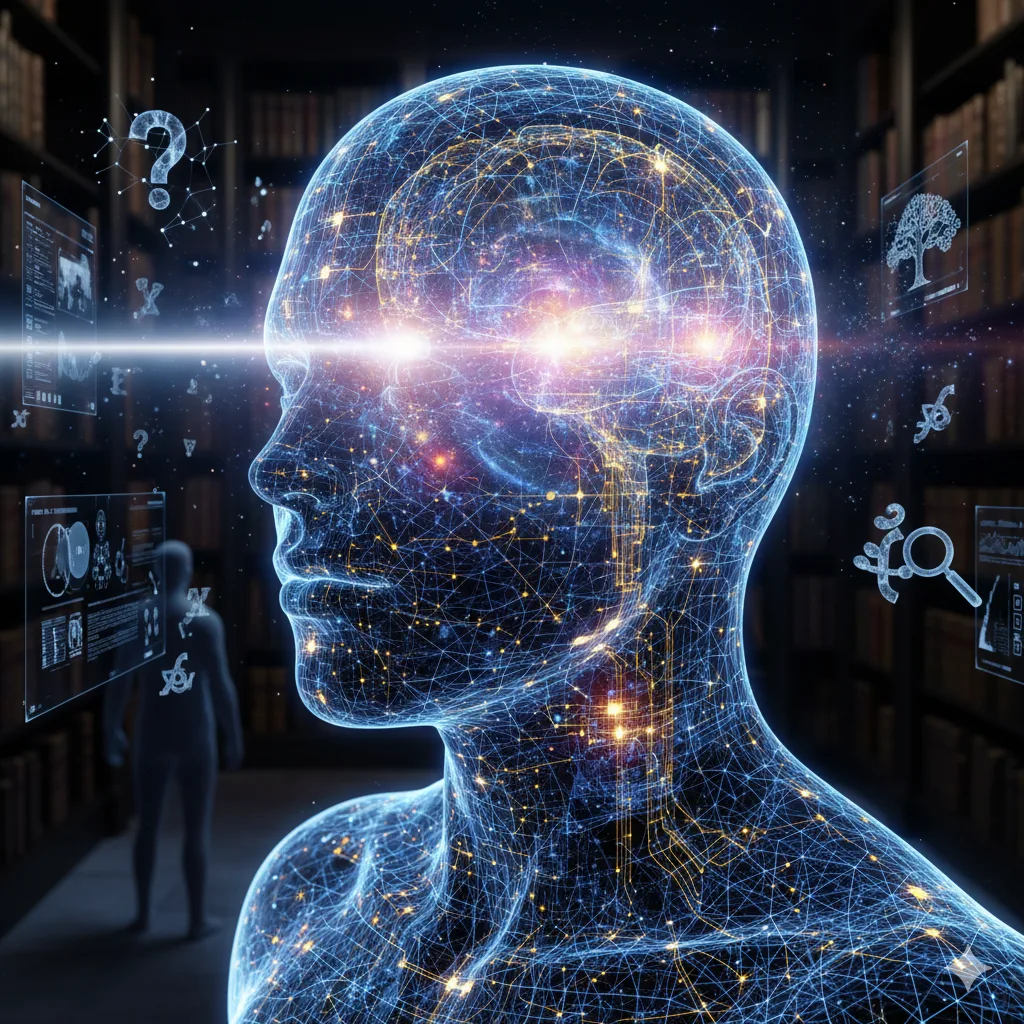
The mind tells us that there is no fixed “I” that can be grasped. The identity we feel is a living construct, changing with every neural impulse. The brain is not a solid reservoir of memories, but an engineer constantly rebuilding itself:
- Neuroplasticity and the Renewed Self: The brain remains plastic, even beyond childhood. This neuroplasticity means our identity is perpetually re-formable. Every new experience, every piece of learning, rewires the connections. Who you are today is literally a person with a different neural fabric than you were yesterday. Identity, scientifically, is a state of continuity, not stasis.
- Memory as an Art Process: Memory is not accurate recording, but a story we continually narrate to ourselves. Every time we recall a memory, we reshape it, coloring it with our current emotion. The “I” of the past is part of the narrative that serves the “I” of the present in its journey of growth.
- The Unity Across Time: What grants us a sense of unity and stability across the years is not the content of the memories, but the consciousness of the “Narrator” itself. It is this awareness that transforms scattered events into a cohesive tapestry of life.
✨ The “I” in the Mirror of Existence (The Philosophical and Contemplative Perspective)
If science dissects the “I” into changing neural networks, philosophy reassembles it into a concept of meaning and freedom. The essence of the self manifests in the moments where we practice our complete awareness:
- The Self Emerges in Choice: The “I” is not what happens to me, but what I choose to be towards what happens. Power lies in the way we process pain and failure, transforming experience into impact. Every decision is a step sculpted into the statue of our identity.
- The “I” and the Other: We discover ourselves in the mirror of others. Relationships are the sacred space where we see shadows we didn’t know we had, and discover love, giving, and belonging. Identity is shaped in interaction and deepens in shared understanding.
- Freedom from the Constraint of Definition: Insisting on defining “who I am” means restricting consciousness. The true self is that which transcends every definition, the one that realizes it is an **ongoing process of “becoming”** rather than a state of “being.”
In conclusion, the question “Who am I?” is not about a finished identity, but about the **power of perception you hold** in this very moment. You are not the sum of your mistakes, nor the sum of your successes, but the awareness that watches all of this and chooses the meaning it wishes to carry. Seek yourself not in your past, but in the infinite possibilities of your existence.
Remember: Meaning is the journey itself, not the destination. And the meaning we create is what immortalizes us.
Writing and Contemplation: Jassim Alsaffar
Digital Identity: Ja16im
A contemplative artist and philosophical writer exploring the symbolism of perception and meaning through digital art, bilingual books, and contemplative scientific articles.


Comments
Post a Comment